Learning German often presents a delightful challenge for English speakers. The two languages share common historical roots. However, this similarity can lead to unexpected amusement, especially with Austrian German words that sound funny.
Many German terms appear familiar yet hold entirely different meanings. Therefore, visitors and new residents frequently find that certain German words sound funny. Meanwhile, others simply sound inappropriate due to their German pronunciation.
Consider the word “Fahrt.” It denotes a journey, trip, or vehicle travel. For many English speakers, however, its pronunciation strongly resembles “fart.” Consequently, expressions like “Gute Fahrt!” (Have a good journey!) or “Ausfahrt” (exit) signage on Austrian motorways often cause giggles.
The term “Mist” also offers a curious case. In Germany, “Mist” typically refers to manure or is a colloquial expletive. By contrast, in Austrian German, particularly Vienna, “Mist” simply means rubbish or waste. Vienna’s waste management department, MA 48, even hosts an annual “Mistfest” – a large community event celebrating waste management.
Another classic “false friend” is “Gift.” While in English it signifies a present, its German counterpart means poison. An Austrian warning you about “Gift” is certainly not offering a gift. Instead, the correct word for a present is “Geschenk.”
“Schmuck” means jewellery or decoration in German. American English speakers, however, might recognize “schmuck” as an informal insult. Similarly, “dick” means thick or fat in German. Therefore, seeing “eine dicke Wurst” (a thick sausage) on a supermarket shelf can often prompt a smile.
Interestingly, misunderstandings can also flow the other way. The English word “after” is perfectly harmless. Yet, its German equivalent, “der After,” is the anatomical term for the anus. Likewise, “Rock” means a skirt in German, confusing children who might expect geological formations in a clothing store.
Furthermore, “Handy” is a common pseudo-English word in Austria. It exclusively means a mobile phone, not something useful or convenient. Locals frequently ask for your “Handynummer” (mobile number).
Even Austrian place names can spark amusement. Many towns feature “Bad” in their names, like Bad Ischl or Bad Gastein. This prefix does not imply a negative quality. Instead, “Bad” signifies a spa or health resort, reflecting Austria’s long-standing spa tradition.
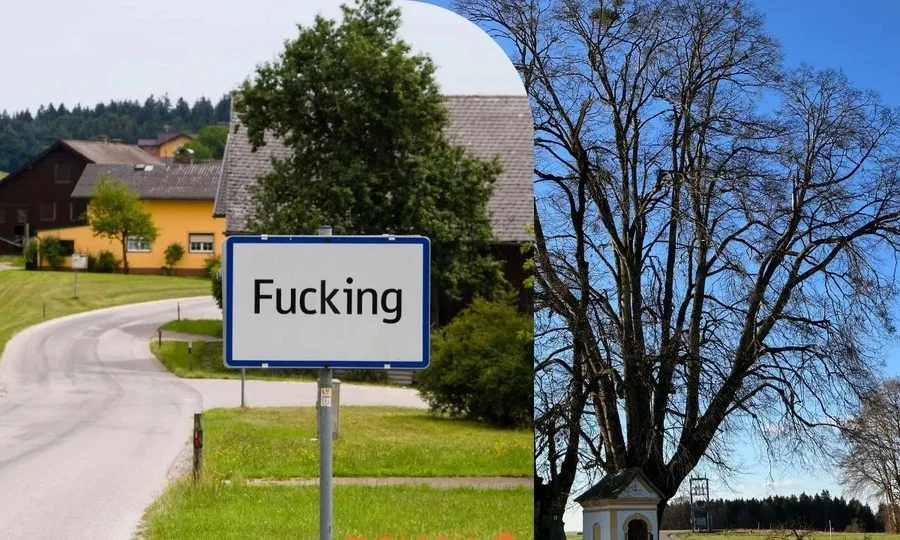
Some localities simply possess unfortunate names for English ears. Lower Austria, for example, has a municipality called Gaming. Visitors might spend a weekend there hiking, not playing video games. Until recently, a tiny Upper Austrian village called Fucking garnered international notoriety. Its name, however, officially changed to Fugging on January 1st, 2021, ending a long-standing photo opportunity.