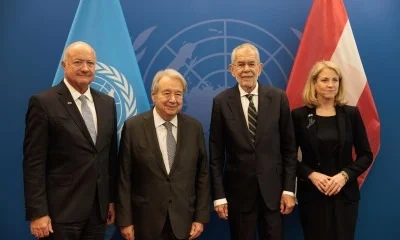
Austria’s top leaders recently advanced diplomacy in New York, notably outlining their UN Security Council vision amid global crises. Federal President Alexander Van der Bellen, Federal Chancellor Christian Stocker, and Foreign Minister Beate Meinl-Reisinger unanimously advocated for strengthened multilateralism during the 81st UN General Assembly. This important trip underscored Austria’s upcoming two-year term as a non-permanent member of the powerful Security Council, starting in 2027.
Foreign Minister Meinl-Reisinger issued a strong warning about the rapid development of artificial intelligence (AI) in military applications. She emphasized the critical danger of losing human control over weapon systems. “Machines must never be allowed to make autonomous decisions about life and death,” the minister stated unequivocally. Responsibility must remain with people, not with the “fastest algorithm.” Therefore, she joined UN High Commissioner for Human Rights Volker Türk in calling for an internationally legally binding framework. Moreover, Meinl-Reisinger secured a migration agreement with Uganda. This pact aims to streamline repatriations while simultaneously establishing legal pathways to the Austrian labor market.
Chancellor Christian Stocker urged the international community towards a realpolitik approach. He stressed that international law must always prevail over the “law of the strongest,” especially as global actors increasingly undermine established rules. Stocker firmly rejected isolationism and populist solutions. Furthermore, he highlighted the importance of diplomatic alliances for neutral, export-oriented Austria. Regarding the need for a seat on the UN Security Council, Stocker made a striking point: “The states between the major power blocs must act together—because if you’re not at the table, you’re on the menu.” Meanwhile, he advocated for United Nations reforms, including greater representation for the African continent. Earlier in his visit, Stocker laid a wreath at the 9/11 Memorial to commemorate the 25th anniversary of the September 11 terrorist attacks.
President Alexander Van der Bellen also focused on preparations for Austria’s upcoming two-year term on the UN Security Council. He held extensive discussions with UN Secretary-General António Guterres. Additionally, Van der Bellen participated in summits concerning Ukraine, such as the International Crimea Platform. The head of state also conducted a notable side event, meeting with New York City Mayor Zohran Mamdani. Mayor Mamdani expressed significant interest in the “Vienna Model” of affordable housing. “A proud European meets a proud New Yorker,” Van der Bellen later shared on social media.
Through numerous bilateral meetings, the Austrian delegation showcased its commitment. Representatives engaged with counterparts from Africa, Oceania, the Middle East, and the Americas. Thus, Austria made clear its determination to act as a bridge-builder and an advocate for a rules-based world order on the global political stage.
However, President Van der Bellen’s sharp criticism of Israel’s actions in the Middle East sparked considerable international and domestic debate. Leading Austrian experts strongly supported his position. For example, international law expert Manfred Nowak stated that Van der Bellen’s remarks were legally precise. Nowak pointed to the escalating situation in the occupied West Bank. Here, the expulsions and killings of Palestinians by Jewish settlers should be unequivocally classified as war crimes. International law expert Ralph Janik further emphasized numerous reports of international humanitarian law violations in the Gaza Strip. Allegations of this nature are already subject to proceedings before the International Criminal Court (ICC) and advisory opinions from the International Court of Justice (ICJ). Nowak explained that the President’s statements challenge Austria’s historically rooted reluctance to criticize Israeli policy. Therefore, the country is now consciously moving away from this long-held stance.