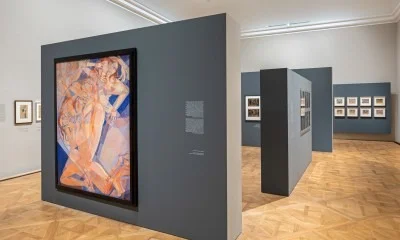
Vienna’s Lower Belvedere is currently celebrating one of Austrian modernism’s most compelling figures. The museum presents “Everything Is Movement,” a comprehensive retrospective dedicated to Erika Giovanna Klien. This landmark exhibition marks the most extensive showcase of her work in nearly four decades.
For Erika Giovanna Klien (1900–1957), movement remained the sole constant in her artistic vision. Her fascination extended to diverse subjects, from birds in flight to spinning food processors. Moreover, the rhythms of dancing bodies often inspired her unique kinetic style.
Approximately 300 exhibits are featured, making this the largest presentation of her oeuvre to date. Curator Verena Gamper aims to elevate Klien’s international profile. She believes the artist’s work merits “full recognition and greater visibility” beyond its current insider status.
Visitors encounter a striking series on flying birds in the opening gallery. Eighteen excerpts span the years 1925 to 1957, showcasing Klien’s artistic evolution. Early pieces display figurative elements, however, later works dissolve into abstract, analytically geometric forms by the 1950s.
The acclaimed “Diving Bird” (1939) serves as the exhibition’s centerpiece. This iconic painting usually resides in the museum’s permanent collection. It now shines brightly as the highlight of this solo showcase.
Klien developed her distinctive aesthetic at the Vienna School of Applied Arts. She studied under Franz Cizek, who encouraged exploring the “rhythmic existence of things.” Her style innovatively combined Expressionism, Cubism, and Futurism.
She meticulously broke down movement into its physical components. Subsequently, she reassembled them geometrically and rhythmically. Works like “Mixer” and “Meat Grinder” (both 1935) exemplify this approach.
Klien’s artistic range was notably broad and often elusive. She explored typography as an independent visual medium, influenced by Rudolf von Larisch. Furthermore, she created the humorous “Klessheimer Sendboten” as an art teacher in Salzburg-Kleßheim.
This unique blend of diary and fictional newspaper featured a self-deprecating portrayal of herself as a chain-smoker. She also delved into marionette theater. Moreover, Klien explored an electric light instrument for moving stage sets and a political dance theater piece titled “The Masses,” composing its music herself.
In 1929, Klien emigrated to New York City. Despite participating in the renowned International Exhibition of Modern Art at the Brooklyn Museum, she did not achieve significant commercial success. Nevertheless, her impact on the art world persisted as an educational reformer.
Her writings reveal her belief that art creation and teaching were intrinsically linked. After her death in 1957, her legacy was far from forgotten. Artists Bernhard Leitner and gallery owner Michael Pabst notably brought her work back into public consciousness from the 1960s onward.
The “Erika Giovanna Klien. Everything is Motion” exhibition runs from September 18, 2026, to January 31, 2027. It is hosted at the Lower Belvedere, Rennweg 6, 1030 Vienna. The museum is open daily from 10:00 AM to 6:00 PM.
Admission costs €20, with concessions available for €16. Children under 19 receive free entry. Visitors can also enjoy a free audio tour and excerpts from the documentary film “Looking for E. G. K.” A preview screening of this film is scheduled for January 30, 2027, at Blickle Kino.